
Best Website Sales Tool For South Africa: WhatsApp vs Contact Forms
The debate between WhatsApp and contact forms isn’t just a tech preference — it’s a revenue decision that affects how many leads you actually close. businesses in South Africa are constantly seeking the best tools to enhance their online sales. Although WhatsApp is a popular online messaging platform, for direct communication with customers, traditional website contact forms still hold their ground as a reliable option for collecting customer information.
Key Takeaways: Best Website Sales Tool For South Africa
- WhatsApp has over 90% penetration in South Africa, making it the most powerful direct sales channel for local businesses — far outperforming traditional contact forms in speed and engagement.
- Read rates on WhatsApp hit 55%, compared to email’s average of around 20%, which means your sales messages are far more likely to be seen and acted on.
- Contact forms aren’t dead — they still serve a critical role for B2B, high-value, and complex enquiries where structured information capture matters more than speed.
- Adding WhatsApp to your channel mix drives a 190% increase in first purchase rate — but only when it’s set up strategically alongside your existing tools, not as a replacement.
- There’s a specific hybrid approach that works best for South African service businesses — and most marketers are only using half of it.
For South African marketers, choosing the wrong tool means slower response times, colder leads, and missed sales. The good news is that the data makes the answer clearer than you might expect. Understanding which website sales tool fits your audience starts with knowing how your customers actually prefer to communicate — and in South Africa, that behaviour is very specific.
WhatsApp Wins on Speed — But It’s Not That Simple
Speed matters in sales. The faster you respond to a lead, the higher your chance of converting them. WhatsApp gives South African businesses near-instant two-way communication, but raw speed alone doesn’t make it the best website sales tool in every situation. What makes WhatsApp powerful is the combination of speed, familiarity, and reach — three things contact forms structurally cannot compete with.
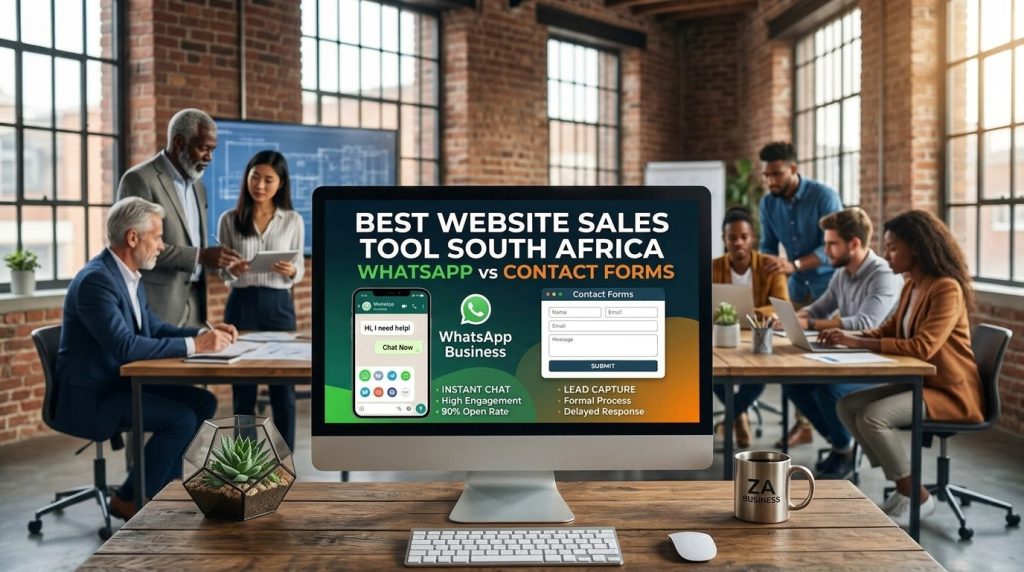
Why South African Shoppers Prefer Instant Messaging
South African consumers have leapfrogged many of the traditional digital touchpoints that dominate Western markets. Mobile-first behaviour, high WhatsApp penetration, and a cultural preference for direct, personal communication have created a market where instant messaging isn’t just convenient — it’s expected. If your website still relies on a contact form as the primary conversion tool, you’re creating friction at exactly the wrong moment.
The buying journey in South Africa often starts on a smartphone, frequently on mobile data rather than Wi-Fi. Customers want quick answers, not forms that promise a response within 24 to 48 hours. That delay is where your competitors step in.
WhatsApp Has Over 90% Penetration in South Africa
WhatsApp isn’t just popular in South Africa — it is the default communication tool for the majority of the population. With over 90% penetration, it reaches demographics that other platforms simply cannot. This includes older buyers, first-time online shoppers, and consumers in smaller towns who may not engage deeply with email or social media but check WhatsApp constantly throughout the day.
This level of reach fundamentally changes the value calculation. When you add a WhatsApp chat button to your website, you’re not offering an alternative — you’re speaking your customer’s first language.
- WhatsApp is used daily by the vast majority of South African smartphone users across all income brackets.
- It reaches rural and peri-urban markets where email adoption remains low.
- Consumers respond to WhatsApp messages significantly faster than to emails or form submission follow-ups.
- Brand familiarity on the platform lowers the psychological barrier to starting a conversation.
Local Data Costs Shape Buying Behaviour
Data costs in South Africa remain a real consideration for many consumers. WhatsApp is data-light by design, and many mobile networks offer WhatsApp bundles or zero-rated access, making it the path of least resistance for communication. Contact forms, on the other hand, often load slowly on budget smartphones or in low-signal areas, creating drop-off before the lead is even captured.
This isn’t a minor UX issue — it’s a structural barrier that costs businesses real money in lost conversions.
Trust is Built Through Conversation, Not Forms
There’s a psychological dimension to this that marketers often overlook. Filling in a contact form feels transactional and formal. Starting a WhatsApp conversation feels human. In a market where trust between consumer and brand is still being built — particularly in e-commerce — that distinction matters enormously. Two-way messaging creates rapport. A form submission creates a ticket.
What Contact Forms Actually Do Well
Before writing off contact forms entirely, it’s worth being precise about where they still perform. Contact forms create a structured record of every enquiry, automatically capture key information, and work without requiring your team to be online. For businesses that receive high volumes of enquiries or need to route leads to specific departments, that structure has genuine operational value.
They also integrate cleanly with CRM systems, email automation platforms, and internal workflows — making them a reliable backend tool even when they’re not the best front-end experience for the customer.
Organised Lead Capture Without Being Online 24/7
Contact forms are asynchronous by nature, which is both their weakness and their strength. A customer can submit an enquiry at 11pm and your team can respond at 9am with full context already captured. For service businesses that handle complex quotes, multi-step onboarding, or lengthy sales cycles, this structured handoff can be more efficient than a WhatsApp thread that requires someone to be actively monitoring a phone.
Better for High-Value or Complex Sales Enquiries
When a customer is enquiring about a R500,000 enterprise software package or a bespoke architectural project, a WhatsApp conversation can feel too casual for the gravity of the decision. Contact forms signal professionalism and give buyers a clear channel to submit detailed briefs. In B2B contexts especially, decision-makers often prefer a formal process that creates a paper trail from the very first touchpoint.
WhatsApp as a Website Sales Tool: Real Numbers
The case for WhatsApp as the best website sales tool for most South African businesses isn’t just anecdotal. The numbers are consistent across multiple independent sources and real-world deployments. When you look at the data side by side, it becomes difficult to argue that a static contact form offers comparable commercial value for direct-to-consumer selling.
These figures reflect what happens when WhatsApp is integrated into a website’s conversion flow as a primary or complementary sales channel — not just as a support chat widget sitting in the corner of the page.
55% Read Rate Compared to Email and Other Channels
WhatsApp messages achieve a 55% read rate, which dwarfs the average email open rate of around 20%. In practical terms, this means that when you send a follow-up message to a lead who engaged with your website, more than half of them will actually read it. That ratio changes the economics of your entire follow-up strategy and makes WhatsApp one of the highest-returning outbound tools available to South African marketers today.
3X More Engagement Than Push Notifications
Push notifications have become increasingly ignored as smartphone users develop banner blindness. WhatsApp, by contrast, sits in an app that people actively open and check multiple times a day. The result is engagement rates that are three times higher than push notifications by response rate — a meaningful gap that compounds over time when you’re running retargeting, cart recovery, or loyalty campaigns.
The difference isn’t just about the channel. It’s about context. WhatsApp messages arrive in a space where people are already having conversations with people they trust, which increases the likelihood of engagement with your brand message.
190% Increase in First Purchase Rate When Added to the Channel Mix
When WhatsApp is added to an existing channel mix rather than used as a standalone tool, businesses have recorded a 190% increase in first purchase rate. That number reflects what happens when you meet customers on a platform they already trust, at the moment they’re ready to buy. For South African e-commerce businesses competing on thin margins, that kind of lift isn’t marginal — it’s transformational.
The key word here is added. WhatsApp performs best as part of a coordinated strategy, working alongside email, social media, and your website — not replacing them. Businesses that swap out all other channels in favour of WhatsApp miss the compounding effect that drives these numbers. For more insights on integrating WhatsApp into your marketing strategy, check out this article on WhatsApp marketing.
26% Higher Conversion Than Equivalent In-App Processes
WhatsApp also delivers 26% higher conversion than equivalent in-app processes, which is a particularly relevant finding for South African businesses that rely on app-based shopping experiences. The reason is friction. In-app processes often require logins, multiple steps, and page loads that slow the buying decision down. A WhatsApp conversation moves at the pace of the customer, in a familiar interface, with no extra steps required to get an answer or complete a purchase.
Where WhatsApp Outperforms Contact Forms for South African Businesses
There are three specific scenarios where WhatsApp doesn’t just outperform contact forms — it makes contact forms look like the wrong tool entirely. These are the use cases where speed, personalisation, and two-way communication directly determine whether a sale happens or doesn’t.
Abandoned Cart Recovery in Real Time
Cart abandonment is one of the most expensive problems in South African e-commerce, and contact forms do nothing to solve it. WhatsApp automated messages, triggered within minutes of a customer leaving your checkout, bring them back into the buying journey at the exact moment when re-engagement is most likely to convert. A well-timed WhatsApp recovery message with a direct link back to the cart — and optionally a small incentive — consistently outperforms email recovery sequences in both open rate and click-through.
The immediacy is what makes it work. By the time a follow-up email arrives in an inbox, many customers have already mentally moved on. WhatsApp catches them while the intent is still warm.
Order Updates and Delivery Confirmations
Post-purchase communication is where many South African businesses drop the ball, and it’s costing them repeat customers. WhatsApp order updates and delivery confirmations give buyers the reassurance they need without forcing them to log into a portal or check an email they may have filtered into a promotions tab. When customers feel informed and looked after, they come back. That repeat purchase behaviour is worth significantly more than the cost of setting up automated WhatsApp notifications.
Upselling During Active Conversations
An active WhatsApp conversation is one of the highest-intent moments in your entire customer relationship. When someone is already talking to your business — asking about a product, confirming an order, or requesting support — the context is perfectly set for a relevant upsell or cross-sell. Unlike a contact form that ends the interaction the moment it’s submitted, WhatsApp keeps the conversation open. A trained sales team or well-configured chatbot can introduce complementary products naturally, without it feeling like a hard sell.
The Right Tool Depends on Your Business Type
There’s no universally correct answer here, and any marketer who tells you otherwise is oversimplifying. The best website sales tool for your business depends on your sales cycle length, average deal value, customer demographics, and how much real-time capacity your team has. What the data does tell us clearly is that for most South African consumer-facing businesses, WhatsApp should be the primary conversion tool — with contact forms playing a supporting role rather than the lead one.
E-Commerce Stores: WhatsApp is the Clear Winner
For direct-to-consumer e-commerce, WhatsApp is the strongest website sales tool available in the South African market right now. The combination of high penetration, low data requirements, instant response capability, and native support for product sharing, payment links, and catalogue browsing makes it purpose-built for the way South African shoppers actually buy online.
Platforms like Shopify integrate directly with WhatsApp through tools like Interakt, enabling automated cart recovery, order confirmations, and proactive marketing messages — all managed from a single dashboard. If you’re running an online store and your primary conversion tool is still a contact form, you’re leaving a measurable amount of revenue on the table every single day.
Service-Based Businesses: A Hybrid Approach Works Best
Service businesses — think digital agencies, insurance brokers, legal consultants, or home renovation companies — operate on longer sales cycles where trust and information gathering both matter. In these cases, neither WhatsApp nor contact forms alone will serve you well. What works is using WhatsApp to initiate the conversation and qualify the lead, then transitioning to a more structured process for detailed scoping, quoting, or onboarding.
The WhatsApp interaction does the heavy lifting of turning a cold website visitor into a warm, engaged lead. The contact form or CRM intake process then captures the structured information your team needs to move forward. Used together, these tools create a sales funnel that is both human and efficient.
The biggest mistake service businesses make is treating the first touchpoint as an administrative step rather than a sales moment. WhatsApp fixes that by making the first interaction feel like a conversation, not a form submission.
Business Type Primary Tool Supporting Tool Key Use Case E-Commerce Store Email Automation Cart recovery, order updates, upselling Service Business WhatsApp (initial contact) Contact Form / CRM Lead qualification, structured intake B2B / Enterprise Contact Form WhatsApp (follow-up) Formal enquiries, multi-stakeholder deals Hospitality / Bookings Booking Form Availability checks, confirmations, upsells
Use this as a starting framework, not a rigid rule. Your actual customer behaviour should always be the final guide — and the only way to know that is to test both tools against each other with real traffic.
Enterprise or B2B: Contact Forms Still Hold Value
In enterprise and B2B sales environments, contact forms retain genuine strategic value. Decision-making involves multiple stakeholders, procurement processes, and often legal or compliance requirements that demand a formal paper trail from the first enquiry. A WhatsApp thread, however helpful for quick follow-ups, doesn’t carry the same weight in a boardroom as a documented, timestamped contact form submission linked to a CRM record. That said, WhatsApp still has a role here — as a follow-up and relationship-nurturing tool once the formal process has begun.
How to Set Up WhatsApp as a Sales Channel on Your Website
Getting WhatsApp working as an active sales channel on your website is more straightforward than most South African business owners expect. The barrier isn’t technical — it’s strategic. Most businesses add a WhatsApp button, get a few messages, and then fail to build the follow-up systems that turn those conversations into consistent revenue. The setup below addresses both the technical and the strategic layer.
Start with the WhatsApp Business App if you’re a small operation, or move directly to the WhatsApp Business Platform (API) if you need automation, multi-agent access, or CRM integration. The API is where the real commercial power lives, and tools like Interakt, Zoko, or Braze make it accessible without needing a developer on retainer.
Once your account is set up, the four steps below will give you a functional, revenue-generating WhatsApp sales channel that works alongside — not instead of — the rest of your digital marketing stack.
1. Add a WhatsApp Chat Button to Your Site
The WhatsApp chat button is your entry point, and placement matters more than most marketers realise. Put it on your highest-intent pages first — product pages, pricing pages, and your checkout flow. A floating button in the bottom right corner works well across devices, but on mobile specifically, make sure it doesn’t overlap your navigation or call-to-action buttons. Tools like Elfsight, WATI, or a simple wa.me link with a pre-filled message make implementation possible in under 30 minutes, no developer needed.
Pre-fill the opening message so the customer doesn’t have to think about what to say. Something as simple as “Hi, I’m interested in [product name] and have a question” reduces the friction of starting a conversation and gives your sales team immediate context. That one small detail can meaningfully improve your button-to-conversation conversion rate.
2. Set Up Automated Welcome and Abandoned Cart Messages
The welcome message is your first impression in the WhatsApp channel, and it needs to do three things: acknowledge the customer immediately, set expectations for response time, and give them something useful while they wait. A message that says “Thanks for reaching out to [Brand]. We’ll be with you in a few minutes. In the meantime, here’s our product catalogue: [link]” keeps the customer engaged and moves them further down the funnel before a human even picks up the conversation.
Abandoned cart messages are where automated WhatsApp truly earns its place in your sales stack. Set your trigger to fire between 15 and 60 minutes after a customer leaves the checkout without completing their purchase. The message should be short, direct, and include a deep link back to their specific cart — not just your homepage. Adding a limited-time offer or free shipping incentive in that first recovery message can push conversion rates significantly higher than email recovery alone.
The sequencing matters too. A single recovery message is good. A two-message sequence — the first focused on the cart reminder, the second (sent 12 to 24 hours later) focused on social proof or answering common objections — tends to recover more revenue across the full window. Keep both messages concise and conversational. WhatsApp is not the place for long-form copy.
3. Use a Multi-Operator System to Handle Volume
Tool Best For Multi-Agent Shopify Integration Pricing Model Interakt E-commerce, Shopify stores Yes Yes Monthly subscription WATI SMEs, service businesses Yes Yes Monthly subscription Zoko E-commerce with catalogue selling Yes Yes Monthly subscription Braze Enterprise, omnichannel campaigns Yes Via API Enterprise pricing WhatsApp Business App Solo operators, micro-businesses No No Free
The free WhatsApp Business App works for a single operator handling low volumes, but the moment you have more than one person responding to customer enquiries, you need a multi-agent platform built on the WhatsApp Business API. Without it, messages get missed, conversations get duplicated, and customers experience inconsistent service — all of which damage the trust you’re trying to build.
Multi-operator platforms like WATI and Interakt assign incoming conversations to specific agents, show conversation history across the whole team, and allow you to set routing rules so product enquiries go to sales and complaints go to support. That kind of structure turns WhatsApp from a personal messaging tool into a proper business sales channel that scales with your team.
For South African businesses experiencing growth, this is the single most important infrastructure decision in your WhatsApp setup. Getting it right early prevents the painful process of migrating your customer conversations — and your opt-in list — to a new platform later.
4. Connect WhatsApp to Your CRM or Shopify Store
WhatsApp in isolation is a communication tool. WhatsApp connected to your CRM or Shopify store is a revenue system. When your WhatsApp platform syncs with your CRM, every conversation is automatically logged against the correct contact record, giving your sales team full visibility of the customer’s history before they reply. For Shopify stores, integrations through Interakt or Zoko allow you to trigger WhatsApp messages based on real order events — purchases, fulfilments, refunds, and abandoned carts — without manual intervention. This is what transforms WhatsApp from a reactive support channel into a proactive sales engine that works around the clock, even when your team isn’t online.
Stop Choosing One — Use Both Strategically
The most commercially effective South African businesses aren’t choosing between WhatsApp and contact forms — they’re deploying both with intention. WhatsApp handles the high-velocity, high-intent moments: the first enquiry, the cart recovery, the post-purchase follow-up. The contact form or CRM intake handles the structured, high-value moments: the detailed brief, the formal quote request, the enterprise onboarding process.
Think of it as a handshake and a contract. WhatsApp is the handshake — warm, immediate, human. The contact form is the contract — structured, documented, professional. You need both to run a business that converts well and operates efficiently. The mistake most South African marketers make is treating this as an either/or decision when the data consistently shows that the channel mix outperforms any single tool used in isolation.
Start by auditing your current conversion funnel. Identify the moments where speed matters most — those are your WhatsApp moments. Then identify the moments where structure matters most — those are your contact form moments. Map a clear path between the two so customers move seamlessly from conversation to conversion without ever feeling like they’ve fallen through a gap in your process.
Sales Moment Best Tool Why First website enquiry Speed and familiarity drive response rates Abandoned cart recovery Immediacy recovers warm intent before it cools Detailed quote or brief submission Contact Form Structured capture ensures nothing is missed Enterprise or B2B enquiry Contact Form Formal process builds credibility Order update and post-purchase High open rates keep customers informed and loyal Upsell during active conversation Real-time context makes offers relevant After-hours lead capture Contact Form + WhatsApp Auto-Reply Form captures the lead; WhatsApp acknowledges immediately
FAQs About Best Website Sales Tool For South Africa
These are the questions South African business owners and marketers ask most often when making the switch to WhatsApp as a primary sales channel — answered directly, without the fluff.
Is WhatsApp Business Free to Use as a Website Sales Tool in South Africa?
The WhatsApp Business App is completely free to download and use for small businesses with a single operator. It includes a business profile, product catalogue, quick replies, automated greeting and away messages, and basic label-based conversation organisation. For most micro and small businesses just getting started, it provides enough functionality to meaningfully improve customer communication without any cost.
The WhatsApp Business Platform — also called the API — is where costs begin. This is the version that enables multi-agent access, CRM integration, advanced automation, and broadcast messaging at scale. Pricing on the API operates on a conversation-based model set by Meta, with costs varying depending on the conversation type:
- Marketing conversations (outbound promotional messages) carry the highest per-conversation cost.
- Utility conversations (order updates, delivery notifications) are priced lower.
- Service conversations (customer-initiated support chats) are free for the first 1,000 per month.
- Platform providers like WATI and Interakt add their own monthly subscription fee on top of Meta’s conversation costs.
- Pricing is listed in USD but billed in ZAR, so exchange rate fluctuations affect your monthly cost.
For most South African e-commerce businesses turning over more than R100,000 per month, the API cost is easily justified by the revenue recovered through automated cart abandonment and order follow-up sequences alone.
Can I Automate WhatsApp Messages Without a Developer?
Yes — and this is one of the most common misconceptions holding South African businesses back. Platforms like WATI, Interakt, and Zoko all offer no-code automation builders that allow you to set up triggered messages, response flows, and drip sequences using a visual interface. If you can build an email automation in Mailchimp, you can build a WhatsApp automation in WATI. The only technical requirement is getting your WhatsApp Business API account approved by Meta, which these platforms handle as part of their onboarding process. Most businesses are fully set up and sending automated messages within three to five business days.
Do Contact Forms Still Convert in 2026?
Contact forms still convert — but context determines whether they’re the right tool. The businesses where contact forms continue to perform well share a few common characteristics:
- They serve B2B or enterprise buyers who expect a formal process.
- Their average deal value is high enough that a longer response window is accepted by the buyer.
- They operate in regulated industries where documented lead capture is a compliance requirement.
- They use the contact form as a secondary channel, with WhatsApp or live chat handling the high-volume, high-speed enquiries.
Where contact forms consistently underperform is in direct-to-consumer e-commerce, where buyers expect near-instant responses and will move to a competitor before your team replies the following morning. If your conversion rate on contact form submissions has been declining over the past two years, this is almost certainly the reason.
The practical solution is to keep your contact form for structured, high-value enquiries while adding WhatsApp as the primary engagement channel for everyone else. That dual approach captures the benefits of both tools without sacrificing the operational structure that contact forms provide.
What is the Best WhatsApp Plugin for a Shopify Store in South Africa?
For Shopify stores operating in South Africa, Interakt is consistently the strongest option. It integrates directly with Shopify to trigger automated WhatsApp messages based on order events, supports multi-agent conversation management, includes a shared team inbox, and offers a WhatsApp catalogue feature that allows customers to browse and purchase products directly within the chat. Zoko is a strong alternative for stores that prioritise conversational selling and catalogue-based commerce, while WATI suits stores that need robust automation and CRM integration more than native Shopify event triggers. All three are available on the Shopify App Store with free trial periods, which makes testing straightforward before committing to a paid plan.
How Do I Handle WhatsApp Enquiries Outside of Business Hours?
The away message is your first line of defence, but it should do more than just say you’re closed. A well-written away message sets the expectation for when the customer will hear back, offers an immediate alternative (such as a link to your FAQ page or product catalogue), and optionally captures their details through a WhatsApp Flow form so your team has everything they need to follow up efficiently in the morning.
For businesses that receive significant after-hours volume, a keyword-triggered chatbot is the next step up. When a customer messages outside of hours, the bot detects keywords in their message — such as “price”, “delivery”, or “return” — and responds with relevant, pre-written answers. This resolves a meaningful percentage of enquiries without any human involvement and prevents leads from going cold overnight. Platforms like WATI and Interakt both include keyword automation as part of their standard feature set.
The goal is to make every after-hours enquiry feel handled, not ignored. A customer who receives an immediate, helpful automated response at 10pm is far more likely to still be engaged and ready to buy when your team follows up at 9am the next morning — which is exactly the kind of pipeline consistency that separates high-converting South African businesses from those that rely on hope as a follow-up strategy.
For those exploring alternatives, here’s a list of top alternatives for contact form builders that can help streamline the process and improve customer interaction.